
Dip-Coat Consistency & Shell Strength
Every dip either builds the shell correctly or introduces a potential defect. Keeping the slurry consistent at the moment of dipping is key to achieving uniform coating thickness and, ultimately, a reliable fired shell.

Every dip matters. Keeping the slurry consistent during dipping helps maintain a uniform coating thickness and, ultimately, a stronger and more reliable fired shell. Changes in viscosity can affect the balance between binder and refractory, leading to uneven coatings that may crack or spall during dewaxing. With automated inline control, foundries can keep slurry flow more stable, helping reduce scrap and achieve more consistent shell quality.
Process context
The dip-coat operation is where the shell is actually made. The wax assembly is dipped into the ceramic slurry, drained, and stuccoed with refractory grain, layer after layer — typically beginning with a fine prime coat for surface finish and continuing with progressively coarser back-up coats for strength. The slurry’s properties at the moment of each dip govern how much it picks up and how evenly it drains, which sets that coat’s thickness and uniformity.
The surface the slurry leaves matters as much as the amount it deposits. A properly drained coat provides an ideal, tacky, receptive surface for the stucco grain to bond to and for the next layer to adhere; a coat that is too thick loads unevenly, while one that is too thin drains away and leaves a poor base. Each dip either builds the shell correctly or seeds a defect.
Slurry viscosity is the variable that most directly governs pick-up and drainage, so holding it constant is what makes coat thickness reproducible from dip to dip and mould to mould. Density tracks alongside as a read on solids loading and on the evaporation that concentrates the slurry over a shift.
Shell strength is the downstream consequence of all this. The wet shell is fired to reach its final strength, dimensions and morphology, and the fired result is only as reproducible as the wet build that preceded it — which makes dip-coat consistency not merely a surface-finish concern but the upstream determinant of whether the shell will survive de-waxing, firing and the thermal shock of the metal pour. Controlling the dip means controlling the slurry at the moment of the dip — continuously, in a tank that evaporates, ages and fouls instruments — which is exactly what an inline, self-cleaning measurement is for.
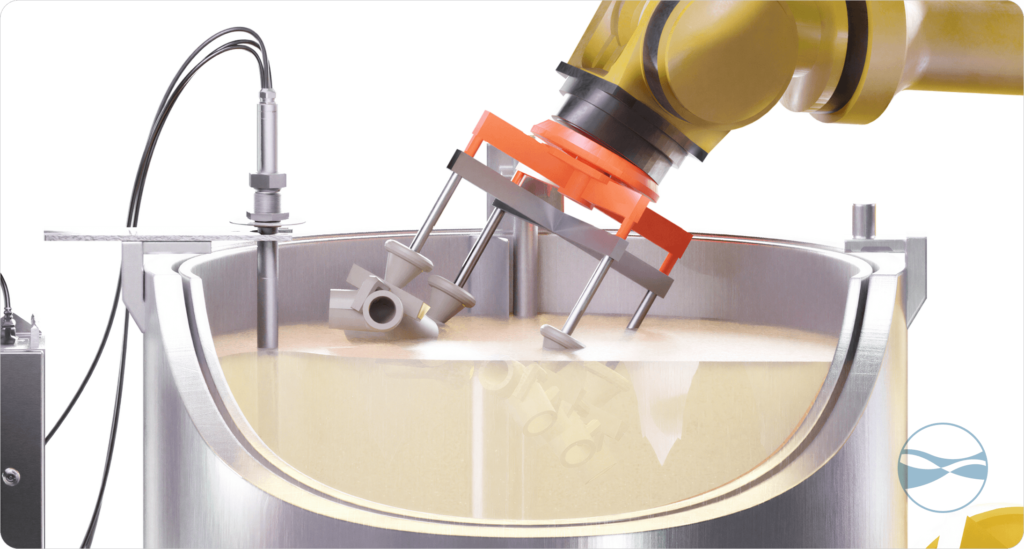
Continuous viscosity and density at the dip tank — so every mould is coated by the same slurry.
The measurement problem
If slurry viscosity drifts between dips, coat thickness drifts with it, and the shell becomes non-uniform. This variation can propagate through the structure as weak spots, dimensional errors, and common shell defects. The problem is that the drift is continuous due to evaporation, temperature, and ageing, while the traditional measurement is intermittent. A flow-cup check taken periodically cannot show what the slurry was doing for the moulds dipped between checks.
The slurry coating the first moulds of a shift can therefore be measurably different from the slurry coating the last. When this happens, the scrap pattern can often follow the time in the shift, which is a sign that the process was reacting to the drift too slowly. An intermittent measurement simply cannot control the slurry tightly enough to eliminate this variation.
The fouling problem is also important here. A probe that becomes covered with ceramic deposits can report a stale or biased viscosity reading. This means the dip process is being controlled based on an incorrect reading, precisely when consistency matters most. The resulting variation in coat thickness may not become visible until it appears as a defect further downstream. There is also a measurement issue in the rotating dip tank:The sensor needs to measure the live, mixed slurry that the moulds are actually seeing, rather than a settled or poorly mixed portion of the tank.
The economics of this gap are unforgiving because the consequence is delayed. A coat-thickness variation introduced during dipping can remain unnoticed through the rest of the wet build and only become apparent after de-waxing and firing, when the shell is weak, cracked, or dimensionally incorrect. By then, the wax, slurry, stucco, and furnace time have already been spent. Detecting the drift continuously in the tank turns a late and expensive failure into an early and much cheaper correction.
Rheonics solution
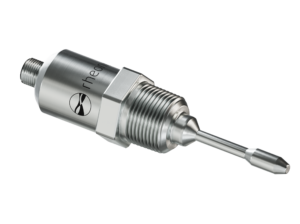
An inline SRD (or Rheonics SlurrySense with CleanWave TM) in the rotating dip tank, the sensor continuously measures viscosity and density while handling the normal operating conditions of the tank. Slurries are a typical, well-suited SRD use case; the sensor accounts for the tank’s rotation and mould insertions as it tracks the live state, confirming it is reading the slurry the moulds actually contact rather than a static sample.
Holding viscosity constant through the dip sequence is what makes coat thickness reproducible from dip to dip and mould to mould. The integrated tracking-and-control approach adds diluent against evaporation so the slurry stays at setpoint across the whole shift, which means every mould the first mould and the last mould, is exposed to similar slurry conditions, helping ensure that each coat is applied consistently.
Self-cleaning is decisive in this fouling fluid: SlurrySense with CleanWave keeps the sensing element free of the tenacious deposits that would otherwise blind a conventional probe, so the reading the dip is controlled against stays honest. Density measured alongside viscosity gives a cross-check on solids loading and evaporation, so the control can distinguish simple water loss (viscosity and density rising together) from a compositional change that needs a binder or refractory correction. he specified measurement accuracy, ±1% of reading for viscosity and ±0.001 g/cm³ for density, helps identify gradual changes caused by evaporation as well as sudden changes following a correction. The result is a dip controlled against a continuous, accurate, deposit-free measurement of the actual working slurry.
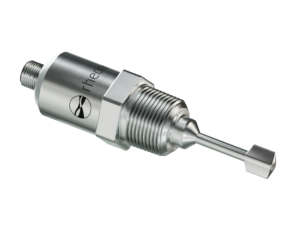
Rheonics SRD
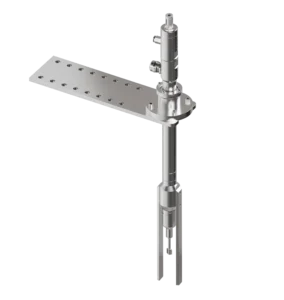
SlurrySense
Signal behaviour
Throughout the shift, the trace shows the slurry becoming more concentrated as water evaporates, with viscosity and density increasing together. The trace also shows the downward steps that occur when the control system adds diluent to bring the slurry back to its setpoint. Mould insertions and spin-speed changes register as the sensor tracks the live tank, confirming the reading reflects the slurry the moulds are being dipped into.
Holding the trace in a narrow band is what makes coat thickness reproducible: every mould is coated by slurry at the same viscosity, so the pick-up and drainage that set coat thickness are the same dip after dip. A departure from the band is a direct, early warning that the next coats will be off-thickness, caught before the moulds are dipped rather than after the shell is fired. The viscosity-density pair is diagnostic: rising together signals evaporation (correct with diluent); diverging signals a compositional issue (correct with binder or refractory, or investigate gelling). Self-cleaning keeps all of this trustworthy over the shift, so the control band the dip is held to reflects reality and not a deposit-coated probe.
Business value
The direct value is uniform coats and the reproducible shells that follow from them. Holding the slurry at a constant viscosity through the dip sequence removes the time-in-shift variation that periodic flow-cup control allowed, so the first and last moulds of a shift are coated alike, which cuts the defects and scrap rooted in coat-thickness variation.
Shell strength is the downstream beneficiary. Published foundry research shows wet and fired shell strength depends on slurry composition and additives (for example, fibre content), which means the wet slurry state has to be held constant for strength results to be reproducible batch to batch. Controlling dip-coat consistency through continuous, accurate measurement is therefore upstream of the structural
integrity that lets the shell survive de-waxing, firing and the metal pour.
Catching drift continuously at the dip also moves defect detection upstream of firing, where the cost of a problem is far lower: a coat-thickness issue corrected at the tank is cheap, while the same issue discovered as a cracked or weak shell after firing is expensive and late. Across a shell room, the cumulative effect is lower scrap, more consistent parts and shells whose strength is reproducible because the wet build behind them was held constant and, because the same continuous signal underpins the Foundry 4.0 traceability record, each shell’s coat-consistency history is captured automatically.
Installation & integration
The SRD or SlurrySense probe is installed in the rotating dip tank with the sensing element fully submerged in the slurry. The probe is positioned so that it measures the well-mixed slurry that the moulds actually contact, rather than material that has settled in one part of the tank. The self-cleaning CleanWave variant is used when ceramic deposits could build up on the sensing element and affect the measurement.
The continuous viscosity-and-density signal feeds the integrated tracking-and-control approach, which holds viscosity at setpoint by managing diluent addition against evaporation and flags gelling or compositional departures. Output integrates with the foundry’s control systems over standard protocols, so coat-consistency control joins the shell-room data and traceability record. Commissioning establishes the target viscosity and density band for each slurry at its working temperature and binder ratio — the conditions under which the prime and back-up coats are designed to be applied; no in-service recalibration is required. For the prime coat in particular, where surface finish is most sensitive to slurry condition, the continuous reading lets the foundry hold a tighter band than back-up coats require, matching control effort to where it most affects the finished part.
Related
See the flagship ceramic-slurry viscosity & density control article for the measurement detail, the prime-coat and back-up-coat pages for per-coat control, and the shell-building cycle article for how coats accumulate into a fired shell.
Key points
- Slurry viscosity governs how much each dip picks up and how it drains, setting coat thickness, uniformity and the receptiveness of the surface for stucco.
- Inconsistent slurry seeds non-uniform coats — weak spots, dimensional error and common shell defects.
- Inline SRD measures density + viscosity continuously in the rotating dip tank; SlurrySense / CleanWave self-cleaning keeps readings honest in fouling slurry.
- Fired shell strength is only as reproducible as the wet build; published studies tie shell strength to slurry composition/additives — so the wet slurry state must be held constant.
A composite pattern: coat thickness that stopped following the clock
Across sites in this area, the recurring pattern is the same: coat thickness, and the shell strength downstream of it, drifted because the slurry was checked intermittently offline, so drift between samples turned into rework and defects. Moving the measurement inline with a balanced torsional resonator made that drift visible in real time, let the loop correct it before it reached the next coat, and produced a continuous record the team could act on and audit. Outcomes reported in this category centre on steadier coat thickness across the shift and fewer after-the-fact shell failures. Composite, unattributed industry pattern — not a specific customer.
Testimony
Lorem Ipsum
In depth: standards, figures and practice
Shell strength is built one dip at a time, and the property that links a dip to the finished shell is slurry viscosity: it sets coat pick-up and thickness, and consistent coats build a consistent, strong shell. When viscosity drifts, coats come out thin or thick, and the shell ends weak, cracked, or over-built — so controlling viscosity controls the cause of strength variation. Today consistency is checked with the flow cup (Zahn) for viscosity and plate-weight tests for pick-up, sampled periodically; these are sound references, but they read the slurry intermittently, so drift between checks is invisible. An inline viscometer on the dip tank sits upstream of that as the continuous control on the property that actually drives coat thickness, keeping every dip consistent instead of discovering a weak shell after firing. Rheonics measures viscosity and density using a balanced torsional resonator (BTR) with no moving parts. The SRV provides a wide viscosity range, while the SRD measures density and specific gravity to help track changes in solids loading. For abrasive and fouling slurries, the self-cleaning option helps keep the sensing element clear.
Inline viscosity measurement does not replace the qualified mechanical tests used to verify shell strength. Instead, it provides continuous control of the slurry condition that influences coating consistency and, ultimately, shell quality.
The effect on scrap and rework should be quantified against your own baseline during a trial.
Reference data
| Parameter | Typical value / standard | Measurement note |
|---|---|---|
| Dip-coat viscosity | ~8–12 s (No. 4 Zahn) prime / ~17 s (No. 5) back-up (examples) | SRV holds it inline; flow cup stays the reference |
| Pick-up / coat thickness | Driven by viscosity per dip | Plate weight is a correlated reference |
| Shell strength | Built from consistent coats; qualified mechanical test | Inline viscosity controls the cause, not the test |
| Density (% solids) | Tracks refractory:binder loading | SRD ±0.001 g/cc (±1 kg/m³) high-accuracy |
| Probe upkeep | Self-cleaning in fouling slurry | BTR, no moving parts; no routine recalibration |
Indicative values and named methods for orientation; confirm your shell-room’s own targets and qualified procedures. Inline viscosity/density supports — and does not replace — flow-cup, plate-weight and the qualified shell/casting acceptance tests.
Why Rheonics?
| What matters | Rheonics SRV/SRD | Typical alternative |
|---|---|---|
| Mounting & vibration | Balanced torsional resonator — insensitive to mounting position and pipe vibration | Many inline/lab instruments are mounting- and vibration-sensitive |
| Properties measured | Density, viscosity and temperature from one probe (SRD); wide-range inline viscosity (SRV) | Often one property per instrument |
| Maintenance | No moving parts; easy to clean; no routine recalibration | Optics, tubes or sources may need cleaning, recalibration or licensing |
| Hazardous areas | Intrinsic Safety (Ex ia) available | Varies by device |
General product characteristics; confirm exact specifications and certificates for your configuration with Rheonics. Inline measurement supports, and does not replace, validated or compendial QC.
Frequently asked questions
What links slurry viscosity to shell strength?
Viscosity sets coat pickup and thickness; consistent coats build a consistent, strong shell. Drifted viscosity produces thin or thick coats and a weak, cracked or over-built shell, so controlling viscosity controls the cause of strength variation.
How is dip consistency checked today?
With the flow cup (Zahn) for viscosity and plate-weight tests for pickup, periodically. These are good references but they sample the slurry intermittently, so drift between checks is invisible.
Where does inline viscosity fit?
Upstream, as the continuous control on the property that actually drives coat thickness — keeping every dip consistent instead of discovering a weak shell after firing.
Does inline viscosity certify shell strength?
No. Shell strength is a qualified mechanical test. Inline viscosity controls the slurry condition that determines strength, complementing the test rather than replacing it.
Across the Rheonics Knowledge Centre
Related content