
Density for Custody Transfer and Fiscal Allocation
Continuous inline density measurement supports accurate volume correction, product verification, and traceability in custody transfer.

In custody transfer, an inline density meter works with the volumetric (or Coriolis) meter and a flow computer that applies industry standards in real time for volume correction. A continuous inline density meter supplies that density at flowing conditions, matched in time to the flow, instead of relying only on a periodic or composite sample.
Process Context
Custody transfer occurs when crude oil or a refined petroleum product changes ownership, with the measured quantity forming the basis for settlement between the parties. At pipelines and terminals, this typically takes place through metering skids, while at oil production facilities, it often occurs at a Lease Automatic Custody Transfer (LACT) unit.
These systems use flow meters, temperature and pressure measurements, and a flow computer to determine the transferred quantity according to the applicable measurement standards and contractual requirements.
In depth: Density’s role in the custody system
Density relates the mass and volume of a fluid and provides information about the product being transferred. Its role in custody-transfer calculations depends on the metering architecture.
In a volumetric metering system, the flow computer applies the meter factor to the indicated volume and corrects it to standard conditions for temperature and pressure. These volume correction factors are calculated using the liquid’s properties, including density, using API MPMS ASTM D1250 standard for crude oils and refined products. This gives the gross standard volume (GSV). The sediment and water (S&W) deduction then gives the net standard volume (NSV), the quantity commonly settled for crude oil, following API MPMS.
Density is also a measure of product quality. In many custody-transfer systems, API gravity can determine a pricing adjustment and is commonly determined from a composite sample collected over a defined period and analyzed in a laboratory. The result gives one value for the period but by itself may not show how the product’s density varied during that period. An inline density meter complements laboratory analysis by providing continuous, time-stamped measurements of the flowing product. These readings can then be corrected to base conditions using ASTM D1250, allowing API gravity to be calculated and compared with laboratory results to identify discrepancies or changes in product quality.
An inline density meter provides valuable information for custody-transfer operations, supporting both volume correction and product quality monitoring.
Reference data
| Element | Role |
|---|---|
| Density meter | Continous density, volume-correction factor input to flow computer |
| Volumetric meter | Measures observed volume |
| Coriolis meter | Measures mass flow |
| Flow computer | Net standard volume calculation |
The density meter supplies one input to the custody calculation; the flow computer combines it with meter volume or mass, temperature, pressure and S&W to produce the settled quantity, following the applicable API MPMS standards.
The measurement problem
Density for custody has traditionally come from composite sample tests in a lab or from density meters that can be vulnerable to the conditions of a live line.
A composite sample can represent the product transferred over a defined period, as long as the sampling system operates correctly and the sample is representative. If product composition or density changes during the transfer, a single composite result may not show when the change occurred. Sampling problems, incomplete mixing, or loss of volatile components during sample handling can also affect the result.
Inline density measurement provides complementary information by recording changes during the transfer itself. Entrained gas, however, can disturb density readings, so the installation and operating conditions must be suitable for the fluid and measurement technology.
Rheonics Solution
Rheonics offers two inline density instruments suited to custody transfer applications, both driven by the SME electronics.
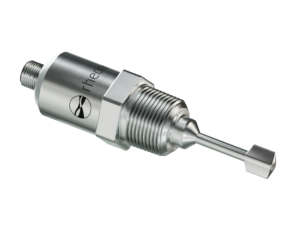
The Rheonics SRD is an inline density and viscosity sensor built on a balanced torsional resonator (BTR). It can be integrated into a metering skid to provide the flow computer with a continuous density at flowing conditions, matched in time to the flow, so the density used in the fiscal calculation is the true fluid density. The SRD measures density, viscosity and temperature with high accuracy.
The DVP is an inline density and viscosity meter based on a torsional tuning fork resonator, rated up to 15,000 psi (1,000 bar) and 200 °C, making it suited to high-pressure, high-temperature custody lines. The DVP can also measure density, viscosity and temperature with high accuracy.
With no moving parts and a range of process connection options, the Rheonics sensors can be adapted to suitable industrial installations.
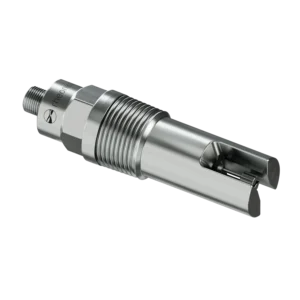
Rheonics DVP
Installation & Integration
The SRD and DVP can be installed in suitable process connections on a metering skid or pipeline. Installation must ensure that the sensing element is appropriately exposed to the fluid and that operating conditions are compatible with the selected probe and process connection.
Rheonics sensors act as independent, complementary measurement inputs to the flow computer. Both instruments report to the flow computer and SCADA through the SME electronics over 4–20 mA, HART, Modbus RTU (RS-485), Modbus TCP, PROFINET, Ethernet/IP, and WirelessHART, so the density signal joins the rest of the metering skid data for automation and traceability. For the complete list of compatible protocols and integration guides, see the Rheonics communication connections support page.
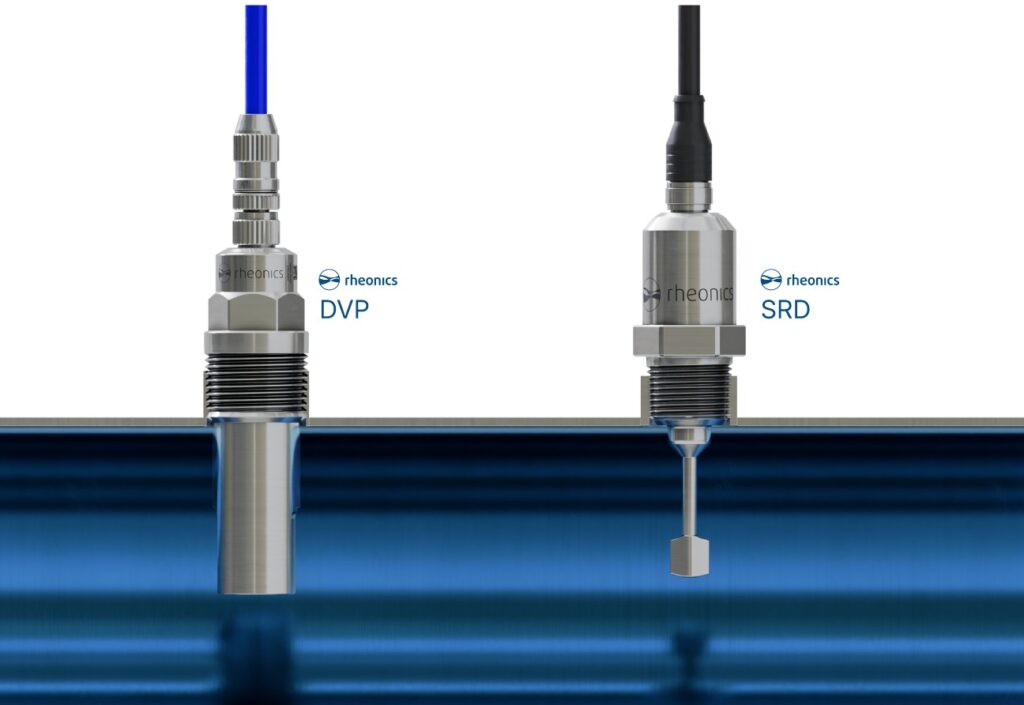
Figure 1: Rheonics inline DVP and SRD
Why Rheonics?
| What matters | Rheonics SRD/DVP | Typical alternative |
|---|---|---|
| Mounting & vibration | Balanced torsional resonator and torsional fork design technology which makes the sensor insensitive to mounting position and pipe vibration | Many inline/lab instruments are mounting- and vibration-sensitive |
| Properties measured | Real time Density, viscosity and temperature from one probe (SRD or DVP) | Often one property per instrument |
| Maintenance | No moving parts; easy to clean; no routine recalibration | Other methods may need cleaning, recalibration or licensing |
| Hazardous areas compatibility | Can be Ex Certified for Zone 0, 1, and 2 | Varies by device |
| Continous measurement | Real Time inline measurement in the direct process | Offline measurements |
General product characteristics; confirm exact specifications and certificates for your configuration with Rheonics.
Frequently asked questions
What role does density play in custody transfer?
Density is used to determine API gravity and can support volume correction and mass-to-volume conversion, depending on the metering system. In a LACT unit, an inline density meter can provide continuous measurements to complement a volumetric or Coriolis meter. The flow computer applies the relevant measurement standards to calculate the settlement quantity, including net standard volume when applicable.
What is ASTM D1250 in custody transfer?
ASTM D1250 is the petroleum measurement standard to obtain the correction factors for temperature and pressure effects on the volume. These factors are used to correct observed volume to standard reference conditions